
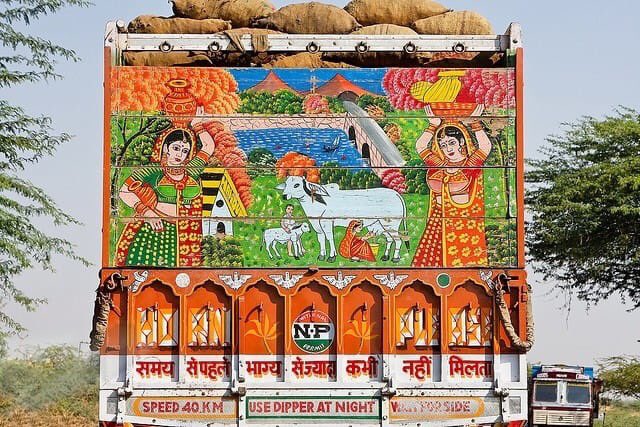

Once upon a time, on the endless highways of India, there existed a unique kind of vehicle. These were not ordinary trucks but symbols of pride, freedom, and culture. They were the “All India Permit” trucks — the ones that could travel across the entire country, from the bustling streets of Mumbai to the remote corners of Ladakh. But what truly set these trucks apart were the vivid artworks that adorned their bodies, transforming them into moving canvases.
The origins of this art form could be traced back to the early days of India’s independence. As the economy began to grow, so did the need for goods to be transported across the length and breadth of the country. The “All India Permit” allowed these trucks to roam the vast landscape, and with the freedom of movement came a desire to express individuality. Drivers and owners, mostly from small villages or towns, would commission local artists to decorate their trucks in a way that was deeply personal and reflective of the region they came from.
Every truck had its own story to tell. The art was never just decoration—it was a reflection of a driver’s spirit, his experiences, his hopes, and dreams. From vibrant peacocks and leaping tigers to intricate floral designs and geometric patterns, the trucks bore the soul of India’s diverse culture.
The truck art was a way for the drivers to hold on to their identities while embracing the vastness of India. It was the country’s mobile museum, where the art of folk traditions, regional symbols, and the everyday life of its people merged into one. From the rolling fields of Punjab to the desolate deserts of Rajasthan, the artwork on the trucks would tell stories of the land, its people, and its past.
So why do drivers take so much care and pride in decorating their trucks? A common reason is that their handicraft is a way of paying homage to the lady in their life who is left back at home whilst they’re on the road, adorning the vehicle with flowers and effeminate human features. In this way, it is more meaningful to the trucker than an outward show of customisation; it is a personification, and a display of devotion to his long distance love.
On one level, the trucking industry of India has played an instrumental role in shaping Indian trade and commerce for around a century. Today though, for many Indians, and for those who love India, this industrial, vernacular art form represents the anthropology, zest for life and burst of exuberant colour that culturally define this part of the world.